Tomás Herrera runs a family taqueria in the Mission District, and for years the lunch rush meant a line out the door and a stack of tickets that grew faster than anyone could read them. Regulars were loyal, but new customers often looked at the queue, checked their watch, and kept walking. Last spring he added an order-ahead app with saved favorites and a pickup counter by the window. The line didn’t disappear, but it changed character. Half the people in it were collecting food they’d ordered from their desks, and the other half were chatting instead of glaring.
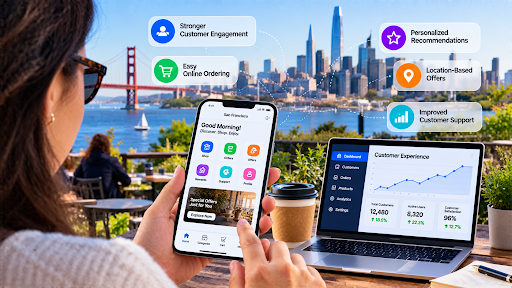
Shifts like that explain why so many owners, from SoMa startups to Sunset District cafés, end up searching for a mobile app development company in San Francisco. In a city where the world’s most demanding tech users also shop, eat, and book appointments, customer experience has become the real battleground. This guide looks at how Bay Area businesses use mobile apps to serve customers better, what separates a useful app from a forgotten icon, and what to plan for before you build one.
Why San Francisco Customers Expect More
San Francisco shapes how the rest of the world uses phones. Uber, Lyft, DoorDash, Airbnb, Square, and Stripe all trace roots here, and so do countless apps people open daily. Residents and visitors carry that expectation into every interaction. If you can summon a car in a few taps, you won’t tolerate a clinic that only takes bookings by phone during business hours.
The customer base is also diverse. A single block might include tech workers, longtime residents, students from UCSF and San Francisco State, tourists wandering from Fisherman’s Wharf, and commuters switching between Muni, BART, and the Clipper app. They speak many languages and use many devices, so a good experience needs to feel simple for everyone.
High costs add another layer. Rent, wages, and supplies make small businesses operate on thin margins. Apps that cut wasted time, reduce errors, and encourage repeat visits aren’t luxuries here. They’re survival tools.
Faster Ordering and Frictionless Payments
The most visible change is speed. Order-ahead apps let customers choose items, customize them, and pay before they arrive. Staff see the ticket in a clear queue instead of deciphering handwriting.
For Tomás, the effects went beyond shorter lines. Mistakes dropped because customers typed their own orders. Average ticket size rose because the app suggested a drink or a side at checkout, something a rushed cashier rarely had time to do. And since people could reorder their usual in two taps, the busiest hours turned smoother rather than chaotic.
Payments follow the same logic. Apple Pay, Google Pay, and card-on-file make checkout nearly instant. Square, which grew up in San Francisco, gave small shops tools that once belonged only to big chains. Tap-to-pay on a phone turns any corner into a point of sale.
Delivery deserves a mention too. Third-party platforms bring new customers but charge commissions that can swallow a margin. Many restaurants now offer direct ordering through their own apps to keep more of each sale and own the customer relationship.
Personalization and Loyalty That Feel Human
People will happily share a little data if it earns them something useful. Apps let businesses remember preferences and reward loyalty without punch cards that disappear in a wallet.
A coffee shop can notice that a customer orders an oat cortado every morning and send a nudge during a slow afternoon. A wine bar can announce a new pour to people who bought a similar bottle. A hair salon can remind clients when their usual cut is due and show open appointments with their favorite stylist.
The trick is restraint. San Franciscans are privacy-conscious and quick to mute anything that feels pushy. Useful messages that arrive rarely beat constant promotions. A good test: would a friendly shopkeeper say this to your face?
Loyalty works best when it’s simple. Points that build quickly, rewards worth having, and no confusing rules. Philz Coffee and similar local favorites show how a well-run program turns daily habits into brand attachment.
Booking, Scheduling, and Service Businesses
Salons, clinics, fitness studios, dentists, and repair shops all rely on appointments, and missed ones cost real money. Mobile apps reduce friction on both ends.
Customers pick a time, receive reminders, reschedule in seconds, and pay in advance if required. Staff see a clean calendar, manage waitlists, and fill cancellations quickly. Many businesses report fewer no-shows once reminders and easy rescheduling are in place.
Healthcare providers, including systems like UCSF Health, offer patient portals and telehealth through mobile tools, letting people message providers, view results, and manage prescriptions. Strict privacy rules like HIPAA apply, so these apps demand careful security.
For boutique fitness and wellness studios, apps are the membership experience itself: class booking, check-in, progress tracking, and community feeds that keep people motivated.
Smarter Customer Support
Support used to mean a phone line and a frustrated wait. In-app chat, push notifications, and AI-assisted help changed the equation.
A customer with a question can message the business from inside the app, attach a photo, and get a reply when it suits them. Chatbots built on modern language models handle common questions like store hours, return policies, and order status, and hand more complex issues to a person. The best setups make the handoff seamless so customers never repeat themselves.
Tracking matters as well. Whether it’s a delivery, a repair, or a custom order, live status updates remove the anxiety of waiting. People forgive delays far more easily when they know what’s happening.
Retail and Omnichannel Shopping
San Francisco is home to several major retail brands, including Gap, Levi’s, and Williams-Sonoma, and they’ve spent years blending physical stores with mobile experiences. Customers browse on their phones, reserve items for in-store pickup, check stock at nearby locations, and use digital wallets to pay.
Smaller shops can borrow the same ideas. A boutique in Hayes Valley can show real-time inventory, offer local delivery by bike courier, and let customers scan a QR code in-store to see styling tips or reviews. Features like these make a small shop feel as capable as a national chain while keeping its personality.
Augmented reality adds more possibilities. Furniture stores let shoppers place a sofa in their living room, and eyewear brands let people try frames virtually. Customers return fewer items when they’ve seen them in context first.
Hospitality and Tourism
San Francisco welcomes millions of visitors each year, and hotels, tour operators, and attractions use apps to ease the journey. Mobile check-in, digital room keys, and in-app concierge chat save time at the front desk. Tour companies offer ticketing, multilingual audio guides, and live updates on schedules and weather, which in a city known for fog and microclimates is genuinely useful.
Language support matters. Visitors and residents speak Spanish, Cantonese, Mandarin, Tagalog, and many other languages. Apps that offer translated menus, instructions, and support invite far more people in.
Accessibility and Inclusion
Accessibility isn’t optional. California’s Unruh Civil Rights Act and the Americans with Disabilities Act have led to legal action against businesses with inaccessible digital experiences, and beyond legal risk, it’s simply good service.
That means supporting screen readers like VoiceOver and TalkBack, offering adjustable text sizes, using strong color contrast, and making buttons easy to tap. Testing with real users who rely on assistive tools finds problems that automated checks miss. Making an app usable for everyone usually makes it better for everyone.
Privacy, Trust, and California Law
California sets some of the strictest privacy rules in the country. The California Consumer Privacy Act and the California Privacy Rights Act give residents rights to know what data is collected, to delete it, and to opt out of its sale or sharing. Businesses that serve customers in Europe also face GDPR.
Practical steps are straightforward: collect only what you need, explain why in plain language, secure it with encryption and access controls, and make deletion easy. Payment processing should follow PCI standards, and any health-related feature needs HIPAA safeguards.
Trust pays off. Customers who believe a business handles data responsibly are more willing to share the details that make personalization work.
Measuring Whether the App Is Working
An app that launches isn’t automatically an app that helps. Smart businesses track a few clear signals:
- Adoption: how many customers download and complete a first order or booking
- Retention: how many return after one week, one month, and three months
- Conversion: how many people who start checkout actually finish
- Customer satisfaction: ratings, reviews on Google and Yelp, and short in-app surveys
- Operational gains: time saved, errors reduced, and no-shows prevented
Numbers are only half the picture. Talk to staff and regulars. Tomás learned more from a lunchtime chat with a longtime customer than from a month of analytics. She told him the “reorder last meal” button saved her five minutes every Thursday.
Planning and Budgeting Your First App
Most San Francisco businesses should resist the urge to build everything at once. A focused first version, often called a minimum viable product, tests the core idea with real customers before you invest more.
Budget depends on scope and who builds it. MVP development Cost for a focused first version, such as ordering plus loyalty or booking plus reminders, often lands between thirty and seventy thousand dollars, with Bay Area rates pushing toward the higher end. Fuller platforms with payments, multiple user types, integrations, and analytics can pass one hundred fifty thousand. Many teams balance price and quality by mixing local product leadership with distributed engineers.
A few habits help projects succeed:
- Pick one painful problem. Solve the queue, the no-shows, or the reorder hassle before anything else.
- Design with customers. Sketch screens, share prototypes, and listen.
- Integrate early. Connect to Square, Stripe, Shopify, QuickBooks, or your reservation system so data flows.
- Plan for both iPhone and Android. San Francisco leans iPhone, but ignoring Android leaves customers out. Cross-platform frameworks can cover both.
- Budget for upkeep. Operating system updates, bug fixes, and security patches never stop.
- Promote in person. QR codes at the counter, on receipts, and on packaging often drive more downloads than ads.
Common Challenges
App fatigue. Customers hesitate to install another app for one café. Some businesses start with mobile web ordering or wallet passes and add a native app once loyalty is proven.
Staff adoption. If the new tool slows the team down, they’ll work around it. Training and a short feedback loop matter.
Overcomplication. Too many features overwhelm people. Simplicity wins.
Rising expectations. Customers compare your app to DoorDash or Uber. Speed and polish matter.
Data security. One breach can destroy years of goodwill.
Frequently Asked Questions
How do mobile apps improve customer experience?
They make ordering, booking, and paying faster, remember preferences, offer instant support and order tracking, and reward loyalty. The result is less waiting and more relevance.
Do small businesses in San Francisco really need an app?
Not always. A good mobile website may be enough at first. An app makes sense when you have repeat customers, loyalty goals, or frequent bookings and want push notifications and a smoother experience.
How long does it take to build a business app?
A focused first version usually takes two to four months. A larger product can take six months to a year, including testing and app store review.
What features matter most for customer experience?
Fast onboarding, easy checkout, saved preferences, order or appointment tracking, helpful notifications, and accessible design.
How can a business get customers to download its app?
Offer a clear benefit like a first-order discount or exclusive rewards, promote it in-store with QR codes, and train staff to mention it.
What privacy laws apply in California?
CCPA and CPRA govern personal data, HIPAA covers health information, and PCI standards apply to payments. Businesses serving European customers may also need to follow GDPR.
Final Thoughts
Customer experience in San Francisco comes down to respect for people’s time. The businesses winning here aren’t necessarily the flashiest. They’re the ones that notice where customers get stuck, then quietly remove the obstacle.
Tomás still stands at the counter each lunch rush, calling names and handing over foil-wrapped burritos. The line hasn’t vanished, and he’d miss it if it did. But now when he hands over a bag, he knows the customer ordered from the elevator, paid with a glance, and will probably reorder tomorrow. The technology stays in the background, and the hospitality stays in front, which is exactly where it belongs.