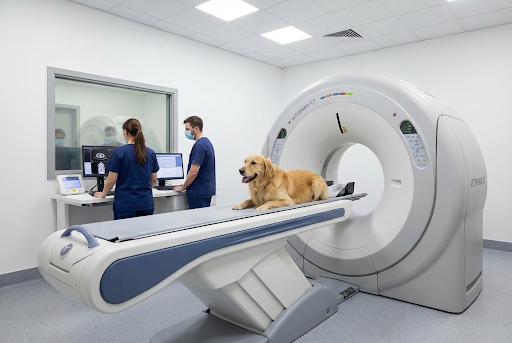
For many complex medical and surgical cases, advanced imaging services can be the key to an accurate diagnosis. A veterinary CT in Marykand scan creates detailed cross-sectional images of your pet’s body, revealing structures that ordinary X‑rays simply cannot show. In Maryland and beyond, this technology has become an essential tool for veterinarians managing trauma, cancer, and neurological disease.
What Is a Veterinary CT Scan?
A veterinary CT scan (computed tomography) uses a rotating X‑ray source and detectors, combined with computer processing, to generate three‑dimensional images. Unlike a single flat radiograph, CT provides multiple slices through the area of interest, which can be reconstructed into detailed views. This allows clinicians to assess bones, organs, and spaces inside the body with far greater clarity.
CT is especially useful for:
- Complex skull and sinus anatomy.
- Vertebral structures and spinal canal size.
- Thoracic and abdominal lesions that are difficult to interpret on standard radiographs.
When Do Pets Need CT Imaging?
Not every patient needs advanced imaging, but Veterinary CT Maryland services are often recommended when:
- Trauma has occurred, such as being hit by a car or falling from height.
- Chronic nasal discharge, sneezing, or facial deformity is present.
- Neurological signs suggest spinal compression or vertebral abnormalities.
- Tumors are suspected and must be staged before surgery or other therapy.
In these situations, the level of detail provided by CT directly influences treatment planning and prognosis.
Advantages of CT Over Traditional X‑rays
While radiographs remain useful screening tools, CT offers several advantages:
- Enhanced contrast and resolution, especially for complex anatomical regions.
- Ability to view structures in multiple planes (axial, sagittal, coronal).
- Better detection of small lesions, fractures, or subtle bony changes.
For example, a veterinary CT scan can reveal tiny bone fragments in the spine, identify masses in nasal passages, or delineate lung nodules that may be missed on regular X‑rays.
Affordability and Value of CT for Pets
Owners sometimes worry that advanced imaging will be out of reach, but many centers offering Veterinary CT Maryland work to provide affordable CT scans for pets relative to the information they provide. While CT is more expensive than standard radiographs, it can:
- Prevent unnecessary exploratory surgery by clarifying internal anatomy noninvasively.
- Shorten the time to a definitive diagnosis, reducing repeated tests.
- Improve surgical outcomes by allowing precise preoperative planning.
When considering cost, it is helpful to weigh the price of CT against the value of faster, more accurate answers and better-informed treatment decisions.
The CT Procedure: What Owners Can Expect
Before CT imaging, pets are typically fasted and undergo a pre-anesthetic assessment, including bloodwork if indicated. On the day of the scan:
- Sedation or general anesthesia is administered to keep the animal still.
- The pet is positioned carefully on the CT table.
- The scanner acquires images in just a few minutes, depending on the region.
- Afterward, the pet is monitored during recovery from anesthesia.
A veterinary radiologist or imaging-trained veterinarian interprets the images and shares findings with the primary clinician, who then discusses results and treatment options with the family.
How CT Findings Guide Treatment
The information gleaned from Veterinary CT Maryland services affects nearly every aspect of case management. CT results can:
- Confirm whether surgery is feasible and determine the best surgical approach.
- Identify whether a mass is resectable or has invaded critical structures.
- Reveal the full extent of trauma-related injuries.
- Assist in planning radiation therapy for certain cancers.
With this level of detail, veterinarians can provide more accurate prognoses and set realistic expectations about recovery.
Conclusion: A Powerful Tool for Complex Cases
Veterinary CT scan technology has transformed how clinicians diagnose and treat many conditions in dogs and cats. By choosing Veterinary CT Maryland services when recommended, owners give their pets access to advanced imaging that can clarify difficult problems and guide targeted therapy. For complex or unexplained illnesses, CT often provides the missing pieces needed to build a confident, evidence-based treatment plan.